Tell Congress: Support the Mini Act!
Send a message to your representatives now.

What Patients Need to Know
About the Inflation Reduction Act’s Healthcare Provisions
How Government Price-Setting Hurts Patients
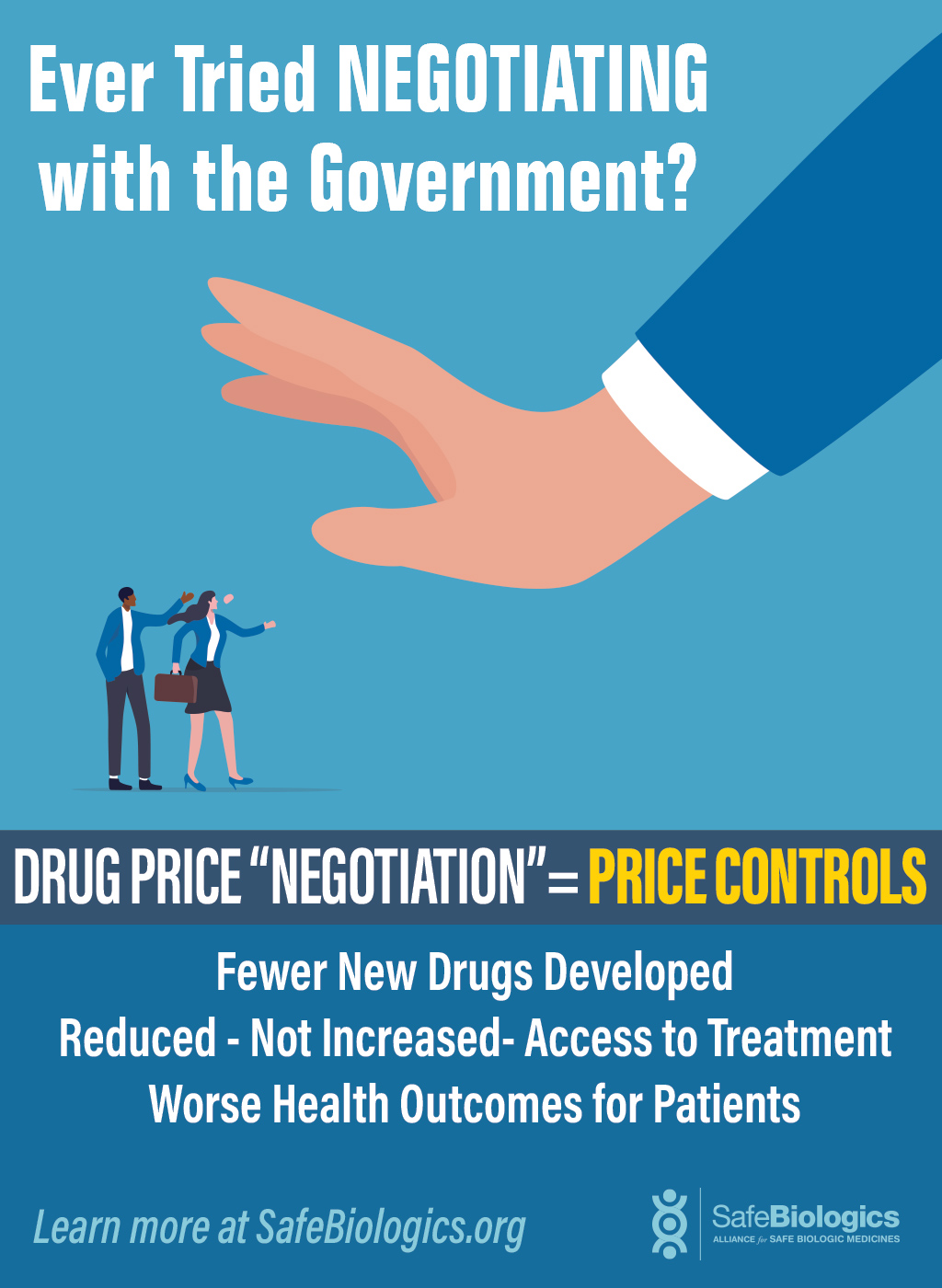
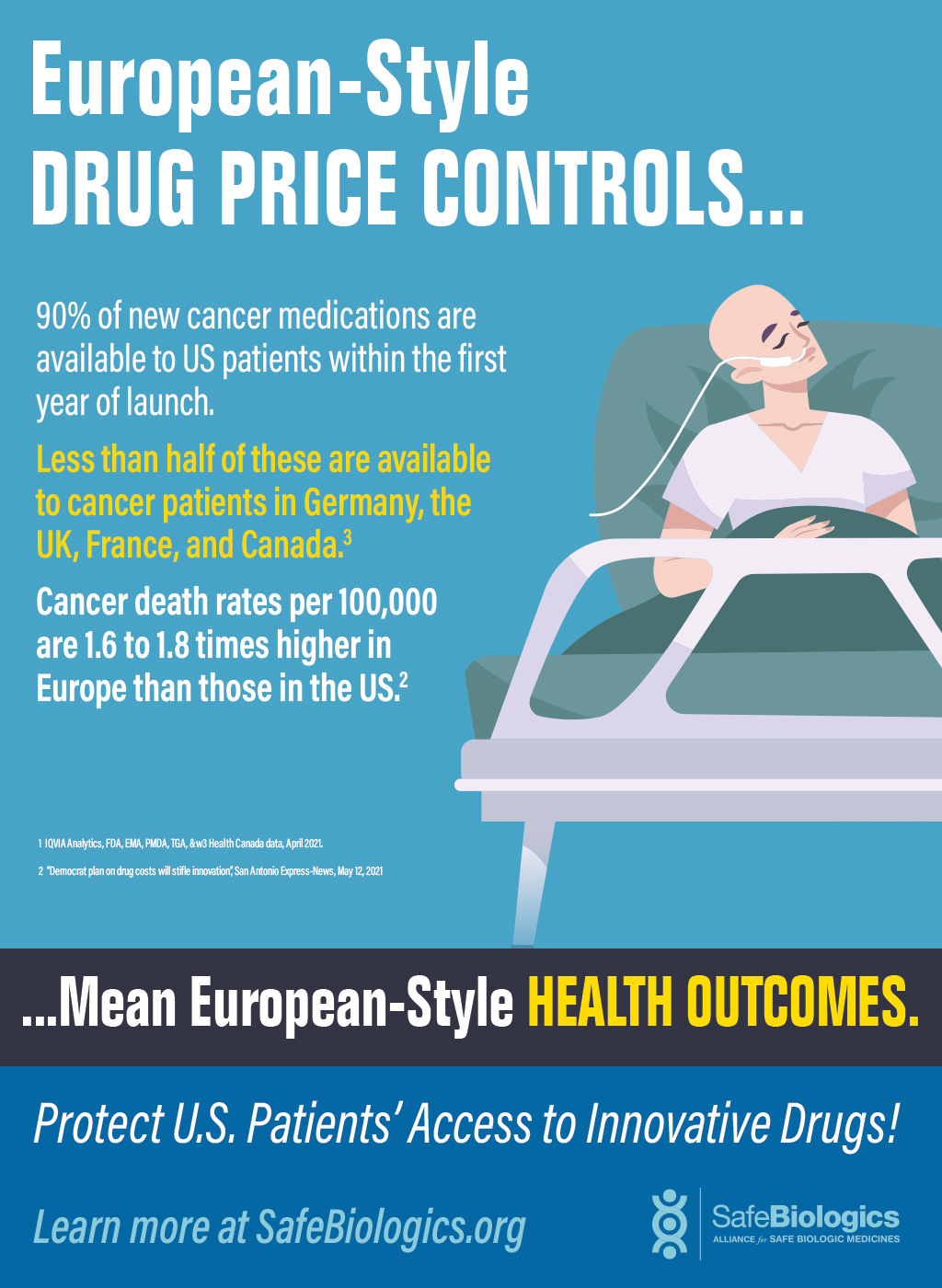
Enacted in 2022, the Inflation Reduction Act (IRA) jeopardizes drug development and patient access to critical treatments, notably through its Medicare “price negotiation” provision, which is effectively government price-setting. Europe’s experience with similar policies led to a collapse in drug development and worse health outcomes including significantly higher cancer mortality rates. Consequently, numerous patient advocacy groups are opposing the implementation of government price-setting in the U.S.

Latest News
Congressman Don Davis Introduces Bipartisan Legislation to Preserve Access to Lifesaving Drugs
Congressman Don Davis (NC-01) Introduced the bipartisan Maintaining Investments in New Innovation (MINI) Act, legislation ensuring continued access to medical therapies developed with genetically targeted technology (GTT). Drugs made with GTT are often designed to treat life-threatening rare diseases, and the MINI Act will incentivize investment in the next generation of cures for patients in desperate need. By removing an artificial bias against GTT cures, the legislation is creating a brighter future for those suffering from serious medical conditions.
Genetically Targeted Technologies (GTT) and the MINI Act
A “MINI” Act Could Be Big for Patients
Game-changing medical technology is on the line. Based on Nobel-prize winning science, genetically targeted technologies take on the proteins that cause disease. The medications are administered once or twice a year to treat rare and debilitating diseases, from Duchenne muscular dystrophy to high cholesterol.
Maintaining Investments in New Innovation “MINI” Act (H.R. 1672)
The MINI Act will help expand research, accelerate advancements in medical breakthroughs, and improve access in healthcare.
What is the MINI Act?
Bipartisan legislation that requires genetically targeted technologies (GTTs) to have market approval for 11 years instead of seven before they qualify for the Medicare Drug Price Negotiation Program. Allowing GTTs to come up for Medicare price negotiation after only seven years discourages investment in this technology.
The Inflation Reduction Act – Implications for Biopharma Companies and Patients
“ASBM fears that the downstream effects of broad government price setting will ultimately reduce consumers’ choice of plans and formularies in Part D—aspects considered to be hallmarks of the program.”
In the NEws
Resources
Learn more about IRA price controls and spread the word with these print and digital materials.
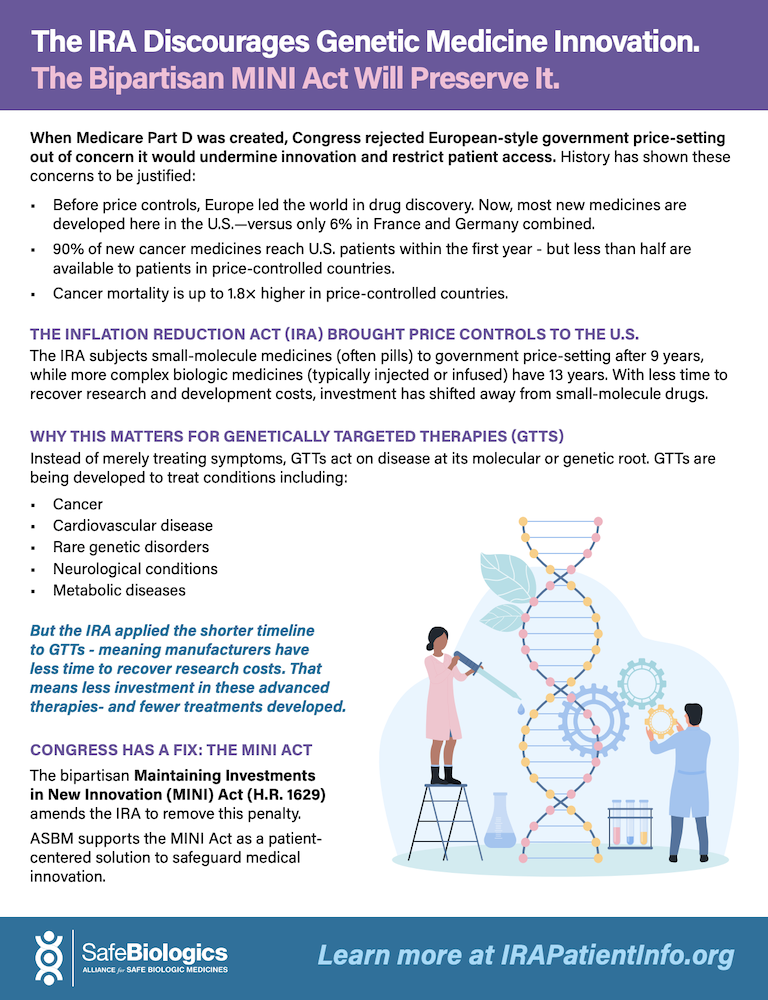
The IRA Discourages Genetic Medicine Innovation. The Bipartisan MINI Act Will Preserve It.
ASBM supports the MINI Act as a patient-
centered solution to safeguard medical innovation.
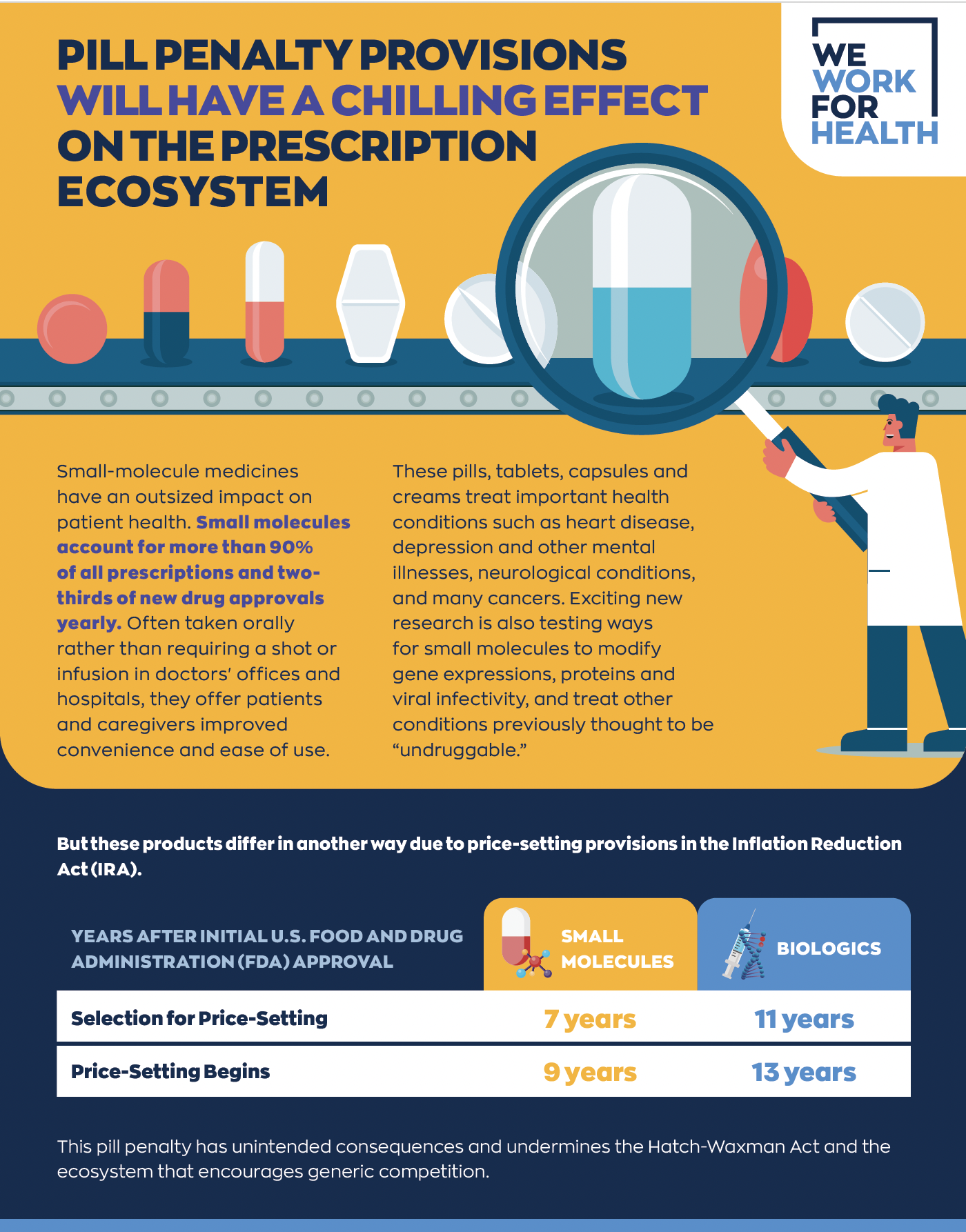
PILL PENALTY PROVISIONS WILL HAVE A CHILLING EFFECT ON THE PRESCRIPTION ECOSYSTEM
March 2025
Small-molecule medicines have an outsized impact on patient health. Small molecules account for more than 90% of all prescriptions and two-thirds of new drug approvals yearly.

Emerging Value in Oncology
July 2023
How ongoing research expands the benefits of oncology medicines

Lilly Sidelined Three Drugs Due To IRA, CEO Ricks Says
Eli Lilly & Co. CEO David Ricks highlighted how Medicare drug price negotiation policies are already impacting R&D investment during a J.P. Morgan investor call.
Download PDF
Click to download
Media

KOL Conversation: The Impact of the IRA on Oncology Patient Care
Features an interview with Dr. Barbara L. McAneny, MD, FASCO, MACP Former President for the American Medical Association and the New Mexico Medical Society (NMMS); and currently CEO, New Mexico Cancer Center.
With Dr. Steve Potts CEO, Anticipate Bioscience
May 26, 2023